📘 Examination System of NIOS Board – Complete Guide (2025)
🏫 Introduction: What Is NIOS Board?
The National Institute of Open Schooling (NIOS) is the largest open schooling system in the world. Established in 1989 under the Ministry of Education, Government of India, NIOS provides flexible and quality education for learners who cannot attend regular schools.
Its motto is “Sarva Shiksha – Education for All.”
Unlike traditional boards such as CBSE or ICSE, NIOS offers a flexible examination system, multiple chances, and the freedom to learn at one’s own pace. This unique model has made the NIOS Board Examination System a revolutionary step toward inclusive education in India.
🧩 Understanding the NIOS Examination System
1️⃣ Structure of NIOS Exams
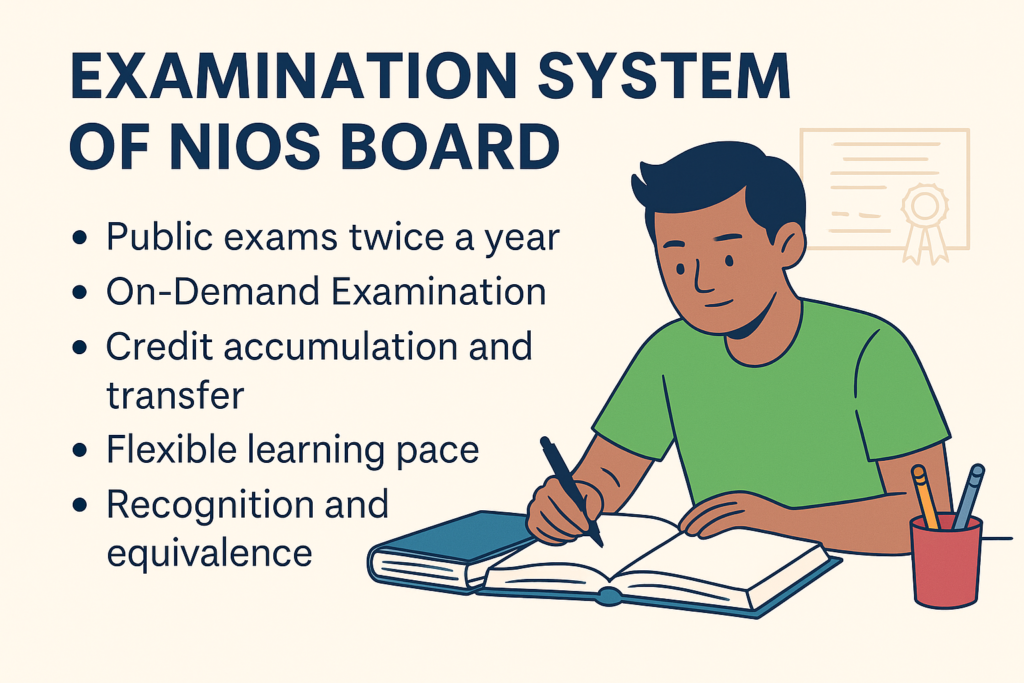
The NIOS Examination System is designed to give students freedom and flexibility. It includes:
- Two main public examinations every year
- On-Demand Examination System (ODES) for personalized testing
- Credit accumulation and transfer facility
- Multiple attempts within five years
- Practical and theory assessments
This learner-centric system ensures that students from all backgrounds — working professionals, sportspersons, or differently-abled learners — can continue their studies without pressure.
📅 NIOS Public Examinations (Twice a Year)
NIOS conducts its public exams twice a year:
- Block I: April–May Session
- Block II: October–November Session
Students can choose whichever block suits their preparation. Each session includes theory and practical exams for both Secondary (Class 10) and Senior Secondary (Class 12) levels.
- Theory Exams: Conducted for three hours per subject
- Practical Exams: Conducted separately at Accredited Institutions (AIs)
The results are usually declared within 7–8 weeks after the last exam.
👉 Example: In 2025, the Class 10 and 12 theory exams are scheduled between October 14 and November 18, while practical exams begin from March 17.
🧠 On-Demand Examination System (ODES)
One of the most unique features of the NIOS examination pattern is the On-Demand Examination System (ODES).
This system allows learners to appear for an exam whenever they feel prepared, instead of waiting for the fixed session.
✅ Key Features of ODES:
- Students can appear any month of the year, except during public exams (April–May and October–November).
- It gives full control to the learner to choose the date, subject, and center.
- The result is declared within 45 days of the exam.
- ODES is available for both Secondary and Senior Secondary levels.
- It follows the same syllabus and marking pattern as the public exam.
This system is ideal for self-learners, dropouts, working people, and students who prefer flexible timelines.
📘 Credit Accumulation and Transfer
NIOS has a Credit Accumulation System, which means:
- You can take exams in one subject at a time.
- Marks of the passed subjects are carried forward until you clear all.
- You get nine chances over five years to complete your course.
If you have passed certain subjects from another recognized board (like CBSE, ICSE, or State Boards), you can transfer up to two subjects’ credits to NIOS.
This policy reduces pressure and supports learners who study at their own pace.
🧾 Subject Choice and Mediums of Instruction
NIOS provides a wide range of subjects at both levels:
🔹 Secondary Level (Class 10)
- Languages: Hindi, English, Urdu, Sanskrit, Bengali, etc.
- Core Subjects: Mathematics, Science, Social Science, Business Studies, Data Entry, Home Science, etc.
🔹 Senior Secondary Level (Class 12)
- Languages: English, Hindi, Sanskrit, Urdu, Bengali
- Electives: Physics, Chemistry, Biology, Political Science, Psychology, Economics, Sociology, Computer Science, etc.
Students can study in multiple languages — Hindi, English, Urdu, or regional languages, making it truly inclusive.
🧮 Examination Pattern and Evaluation
1️⃣ Theory Exams
- Duration: 3 hours
- Marks: 80 marks (theory) + 20 marks (practical/internal) for most subjects.
- Objective and subjective questions are included.
2️⃣ Practical Exams
- Conducted at designated Accredited Institutions (AIs).
- Include experiments, projects, and viva-voce.
- Evaluated by internal and external examiners.
3️⃣ Evaluation & Grading
- Grades are awarded based on marks obtained:
- A – Excellent (80–100%)
- B – Very Good (60–79%)
- C – Good (45–59%)
- D – Average (33–44%)
- Students must score a minimum of 33% marks to pass.
📑 Registration and Examination Process
Step 1 – Admission / Enrollment
Students register online at nios.ac.in by providing documents and selecting subjects.
Step 2 – Exam Form Filling
For every session, the learner must fill out the Examination Form online and pay the fee.
Step 3 – Hall Ticket
NIOS issues the hall ticket about 2–3 weeks before the exam.
Step 4 – Exam & Evaluation
Students appear for theory and practical exams at their chosen centers.
Step 5 – Results
Results are declared online within 6–8 weeks of the last exam.
Step 6 – Certification
After clearing all subjects, NIOS issues the Secondary or Senior Secondary Certificate, valid for college admissions and government jobs.
🎓 Result Declaration and Certificates
NIOS publishes results on its official website. Learners can check by entering their enrollment number.
After passing all subjects, students receive:
- Marksheet
- Provisional Certificate
- Migration Certificate
- Final Pass Certificate
NIOS certificates are recognized by all universities, government organizations, and competitive examinations (like UPSC, SSC, NEET, JEE, etc.).
💡 Advantages of NIOS Examination System
✅ 1. Flexible Learning
Students choose their subjects, exam session, and preparation pace.
✅ 2. Stress-Free Evaluation
The ability to attempt one subject at a time reduces exam pressure.
✅ 3. Second Chance for Dropouts
NIOS offers a pathway for school dropouts, working individuals, or homemakers to complete education.
✅ 4. Multilingual & Inclusive
Exams and study materials are available in many Indian languages.
✅ 5. Recognized Worldwide
NIOS certificates are accepted globally for higher education and employment.
✅ 6. On-Demand Exams
The ODES feature gives learners complete freedom to decide when to appear.
⚠️ Challenges of the NIOS Examination System
Despite its flexibility, NIOS faces certain challenges:
- Limited ODES exam centers in smaller cities.
- Delay in result publication in some sessions.
- Lack of awareness among students about recognition and equivalence.
- Technical issues during online registration or result checking.
However, NIOS continuously works to improve these aspects through digital platforms and regional centers.
📚 Tips to Score Well in NIOS Exams
- Prepare a timetable and stick to it.
- Study from NIOS self-learning materials (SLMs).
- Solve previous year question papers.
- Attempt the NIOS On-Demand Exam only when fully prepared.
- Write clear, structured answers using proper headings.
- Revise at least one month before the exam.
- Attend the practical sessions seriously, as they add easy marks.
🧭 Recognition and Equivalence
Many learners often ask: Is NIOS valid?
The answer is Yes!
- NIOS is recognized by the Ministry of Education, Government of India.
- It has full equivalence with CBSE and other state boards.
- Certificates are valid for **NEET, JEE, UPSC, SSC,